How a Digital Twin + AI radically improves your production planning

  • Home
  • Blogs
  • How a Digital Twin + AI radically improves your production planning

Determine the optimal scenario over and over again

By building a digital copy of your factory, you can simulate production scenarios. In technical terms, we call this a digital twin. Depending on such factors as production times, constraints, orders, inventory, production line characteristics and changeover times, an enormous number of possible scenarios are created for planning production. By having AI perform scenario analyses to always choose the best planning scenario, you can achieve optimal planning. Read in this blog how you can radically improve your production planning with a digital twin and AI.

What is a digital twin?

A digital twin is a digital copy of a physical process, object or system that is fed with data from the real world (think of machine speeds, working hours, etc.). In this digital environment you can visualize and change the actual situation, performance and behavior of the factory without disturbing the real process. In the digital twin, you can calculate endless scenarios and immediately see the impact of your choices. A digital twin makes it possible to run decisions virtually in your own risk-free test environment before implementing them on the shop floor. This allows you to make well-considered choices about the purchase of an expensive new machine, for example.

Production Planning with a Digital Twin + AI
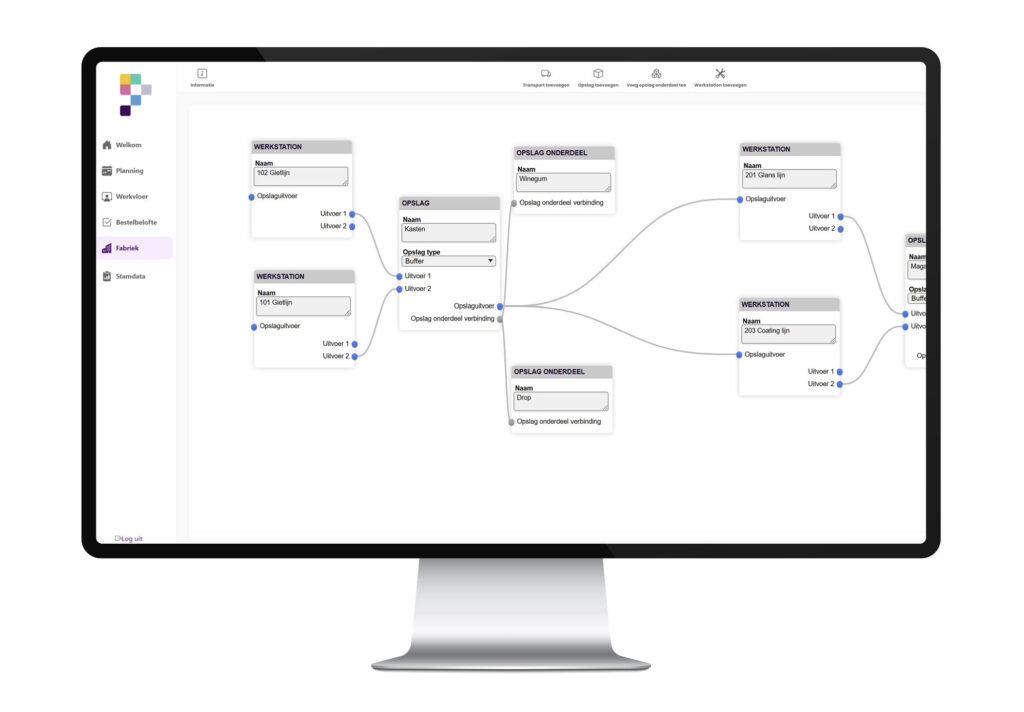
Simple representation of a digital twin in a production environment.

How AI and scenario analysis work together

Due to various constraints – think of product variations, available machines, changeover times, drying or curing times, stock locations and customer deadlines – a multitude of possible planning combinations often quickly arise. This makes it virtually impossible for a planner to determine the optimal scenario in a short period of time. This creates additional challenges when something changes at the last minute. For example, due to a breakdown on a line or an important order that comes in between.

AI is ideally suited precisely to quickly calculate the most optimal scenario in such a situation: it simulates, evaluates and ranks thousands of options on indicators (cost, delivery time, waste), so that you instantly choose the best schedule without having to puzzle manually. In fact, AI is built to sift through complex, high-dimensional problems and learn from data – exactly what planning in a digital twin requires. Some features of AI that make this possible are:

  • Scale with complexity: where humans are bogged down by combinations and constraints, AI can simulate and quickly evaluate millions of scenarios.
  • Multi-goal optimization: AI models (from heuristic search algorithms to reinforcement learning) simultaneously optimize for multiple KPIs – delivery time, cost, waste – and find actionable trade-offs.
  • Deals with uncertainty: probabilistic models and simulations account for outages, variable delivery times or demand fluctuations and choose robust plans rather than fragile “best-case” solutions.
  • Real-time adaptation: AI can continuously learn from current production data and adjust schedules as soon as circumstances change (breakdowns, rush orders), so that schedules are always current.
  • From data to decision: AI makes invisible patterns and dependencies visible and translates them into concrete, executable schedules – allowing planners to focus on exceptions and strategic improvements.
AI Scenario's
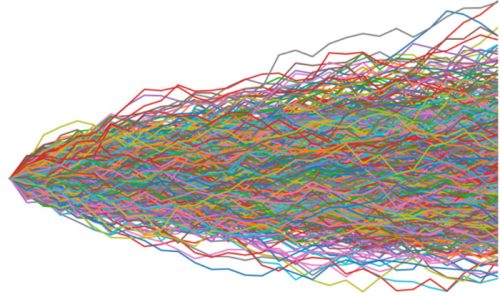
With AI, you can then determine the best path in any situation.

Application of a digital twin and AI in production planning

Often production processes contain many variables, think: machine availability, changeover times, drying or curing times, product restrictions, packaging lines, and customer deadlines. Human planners can do a lot, but once the number of combinations increases it becomes impractical to find the optimal choice manually (in Excel). Indeed, even fairly simple examples in production planning quickly lead to hundreds of possible scenarios.

AI in a digital twin combines the power of both technologies: the model simulates thousands (or more) of planning routes, evaluates them against goals (on-time performance, minimum cost, minimum changeover time, least possible waste) and ranks the best options within seconds. With that, you always choose the schedule that is most efficient at that moment.

To illustrate: suppose you produce 10 products, with 2 machine options for production, 5 packaging variants and 3 packaging machines, that already creates 300 possible scenarios. And that does not take into account, for example, special treatments per product or other restrictions. A human planner cannot weigh that.

What does production planning with a digital twin and AI provide?

In Planwisely’s practice, we often encounter the following benefits after implementing a digital twin with AI optimization:

  • Lower operating costs: by reducing changeover times (decrease of 5 – 10%), we increase production capacity and extend the technical life of machines.
  • Less workload for planners: from manual puzzling to exception management to true optimization. Planners can take targeted action when the AI identifies an anomaly.
  • Improved customer satisfaction: because the AI can plan better, delivery reliability is increased (3-5%) and thus customer satisfaction.
  • Less waste: (typically a 10% reduction) and thus an increase in sustainability because you use resources more efficiently.
  • More and faster innovation: because new product variants or process changes can first be safely tested in the digital twin.

Small percentage improvements in planning often translate directly into leverage in financial gains and CO₂ reductions: less spoilage, fewer residual streams, fewer rush shipments and better machine utilization rates.

Discover the improvement potential in your production environment

A digital twin coupled with AI transforms production planning from guesswork to predictable, continuous optimization. Through scenario analysis, you always choose the planning path that guards delivery times, lowers costs, reduces planner workload and minimizes waste – with direct gains for both operational performance and circularity goals.

Want to see what this looks like in practice? Planwisely’s Digital Factory makes the digital-twin approach tangible: in a safe, digital environment you test planning scenarios and see the operational and sustainable effects immediately. Schedule a short introduction to discuss the improvement potential within your production environment without obligation, do the impact scan or download our fact sheet.


Planwisely APS

Want to learn more about Planwisely’s Advanced Planning & Scheduling system? Download the factsheet with more information.

Related inspiration papers

Schedule an introduction

Find out what potential AI has for your production planning.