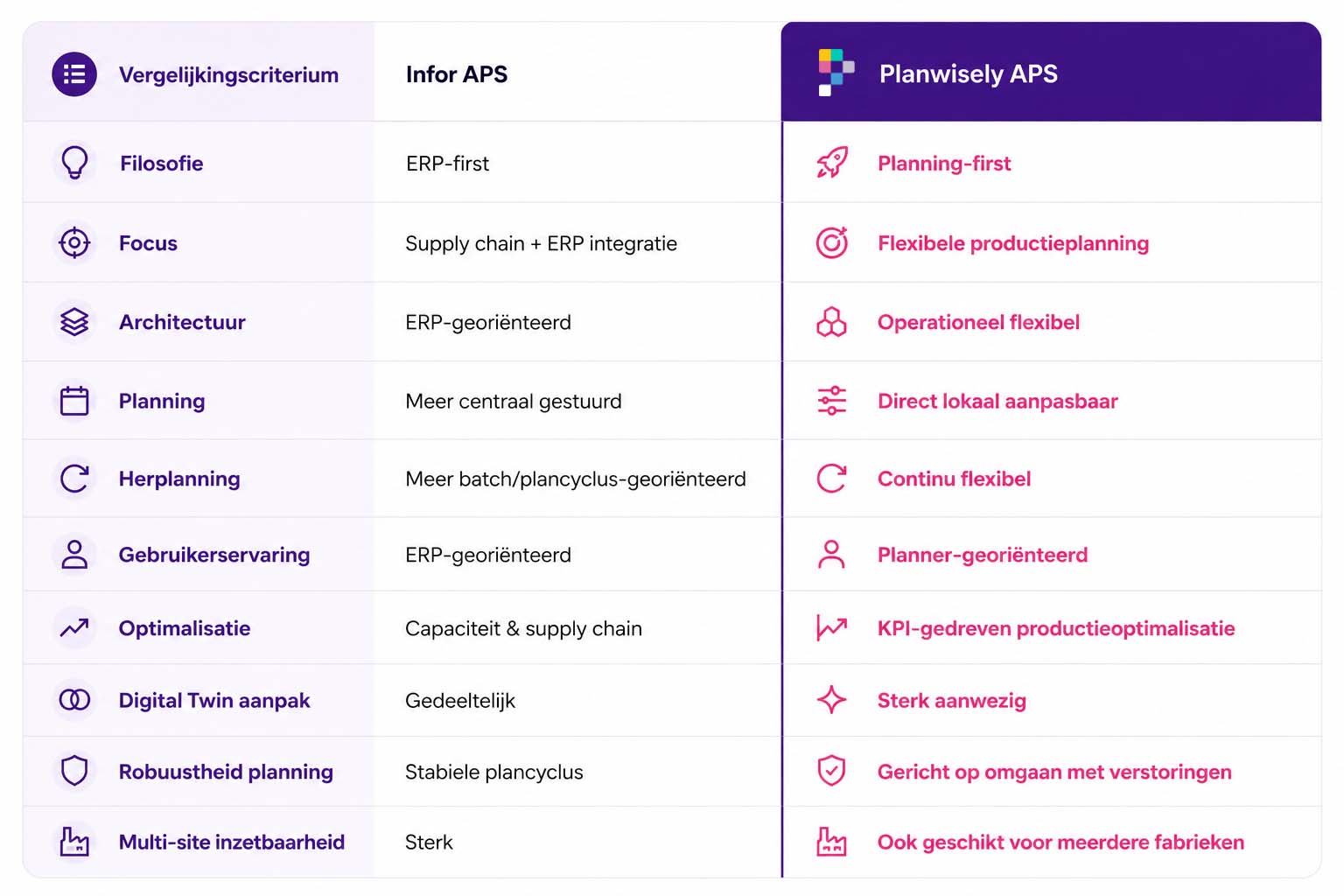
Ultimately, the biggest difference lies in the design philosophy.
Infor APS is built on ERP logic:
- inventory,
- routing,
- procurement,
- capacity,
- transactions,
- and long-term planning.
Planwisely APS is based precisely on the day-to-day reality of production planners:
- ongoing changes,
- bottlenecks,
- operational disruptions,
- KPI optimization,
- and quick decision-making.
Why Flexibility in Production Planning Is Becoming Increasingly Important
Traditional APS systems were historically designed for more stable production environments. Many schedules were recalculated periodically through batch runs or fixed planning cycles.
But modern manufacturing works differently.
Today, production plans are constantly changing due to:
- supply chain disruptions,
- shorter delivery times,
- staff shortages,
- higher customer expectations,
- and fluctuating demand.
Research on AI-based planning in flexible production systems shows that traditional planning techniques struggle to adapt quickly in dynamic environments.
This is also evident in practice. In discussions within manufacturing communities, planners regularly point out that Excel and traditional ERP planning are not flexible enough to accommodate daily changes on the shop floor.
That is precisely why there is a growing need for APS software that:
- can be customized immediately,
- supports planners during disruptions,
- and can flexibly optimize based on various KPIs.
Digital Twin and Scenario Optimization
An interesting distinction between the two systems is their approach to the factory itself.
Infor APS uses a virtual model of resources, capacity, operations, and material flows. This enables the execution of scenarios and capacity calculations.
Planwisely takes this a step further by explicitly building a virtual factory (Digital Twin) in which:
- production steps,
- dependencies,
- intermediate stages,
- workstations,
- and production conditions
are simulated.
This allows planners to directly compare different scenarios and optimize them based on their key KPIs.
For example:
- What happens to delivery times if a production line goes down?
- Which schedule minimizes changeover times?
- How can we reduce the loss of raw materials?
- Which scheduling method ensures the highest delivery reliability?
- How can we reduce manual tasks on the shop floor?
Optimizations like these are becoming increasingly important in modern production environments.
When is Infor APS a better fit?
Infor APS is a strong choice for organizations that:
- are already deeply embedded in the Infor ERP ecosystem,
- manage multiple international production sites,
- have complex supply chains,
- and place a strong emphasis on governance and standardization.
For large enterprise production environments, that integration can be a major advantage.
When is Planwisely a better fit?
Planwisely production planning software is particularly useful for manufacturing companies that:
- want to plan more flexibly,
- want to be able to respond more quickly to disruptions,
- want to create more robust schedules,
- to give planners more control,
- want to optimize based on operational KPIs,
- and need scenarios that can be adapted immediately.
This applies not only to individual production sites, but also to larger manufacturing organizations with multiple medium-sized plants where flexibility and local optimization are important.
Conclusion
Both Infor APS and Planwisely APS solve complex production planning problems, but from different perspectives.
Infor APS is primarily:
- ERP-driven,
- supply chain-oriented,
- and designed for enterprise manufacturing.
Planwisely APS focuses specifically on:
- flexible production planning,
- robust schedules,
- AI-driven optimization,
- KPI-driven scheduling,
- and scenarios that can be customized on the spot.
The right choice therefore depends primarily on the following question: Do you want to focus primarily on centralizing ERP processes, or on being able to flexibly adapt production planning to the day-to-day realities of the factory?
Want to learn more about modern APS software and AI-driven production planning? Check out: